About 3-Way Pressrestatic Shunt Valves
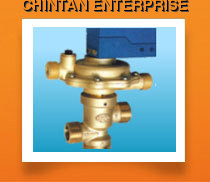
3-Way Pressrestatic Shunt Valves for Domestic Boilers Series VDP
MAIN CHARACTERISTICS AND OPERATION : VDP valves are use in domestic boilers with heat exchangers for instantaneous domestic hot water production. When the user requests domestic hot water, the VDP valve shunts the flow of water from the primary circuit of the boiler towards the instantaneous heat exchanger (boiler) excluding the heating circuit; this shunted flow is modulated depending on the domestic hot water flow rate until it reaches the rate where the microswitch trips. The VDP valve is equipped with auxiliary microswitches and with an eventual flow rate regulator (reducer). There is a version that besides the above mentioned characteristics is able to modulate the domestic water flow rate in a wide entrance pressure range thanks to a by-pass (VDP/M series). All versions are also available with secondary heat exchanger (see fig.3). In this case they are called secondary groups. HYDRAULIC CHARACTERISTICS :
- Max temperature primary 110C, secondary 70C
- Rated pressure PN primary 4.5 Kg/cm, secondary 10 Kg/cm
- Max heat exchanger opening P 0.5 bar
- Max opening P for heating system path 0.3 bar
- Domestic water flow rate to activa te microswitches (1.4, 1.7 and 2.1) 0.3 l/min.
- Domestic water flow rate to relea se microswitches flow rate intervention -0.3 l/min.
Versatile Application & Durable ConstructionDesigned for rigorous environments, these 3-way shunt valves are ideal for HVAC systems, industrial processing, water purification, and chemical distribution. Options of stainless steel, brass, or cast iron provide robust mechanical strength, while various sealing materials enable compatibility with a wide range of media, including water, oil, and gas.
Flexible Installation & Reliable OperationMount the valves horizontally or vertically to suit your piping layout. Both flanged and threaded end connections are available, supporting international standards including ANSI, DIN, and JIS. Manual handwheel and gear-operated mechanisms grant precise flow control with equal percentage or linear flow characteristics, ensuring adaptability for your specific process needs.
Comprehensive Testing & Industry ComplianceEach valve undergoes 100% hydraulic and pneumatic testing to meet stringent Class VI leakage requirements. The body thickness is engineered as per standard design, delivering operational safety even under pressures of PN16, PN25, or PN40. Superior finishespolished or coatedbolster corrosion resistance and enhance longevity in demanding environments.
FAQs of 3-Way Pressrestatic Shunt Valves:
Q: How do I select the appropriate seal material for my 3-Way Pressrestatic Shunt Valve?
A: Seal material depends on the media and operating temperature. PTFE offers excellent chemical resistance for aggressive fluids; NBR is suitable for oils; EPDM is ideal for water and steam applications. Assess your process requirements to choose the most compatible seal.
Q: What are the benefits of the equal percentage and linear flow characteristic options?
A: Equal percentage flow provides non-linear response for precise control at lower flow rates, making it preferable for systems requiring gradual adjustment. Linear flow delivers consistent proportional control, suitable for applications needing straightforward throughput modulation.
Q: When should the gear-operated mechanism be chosen over handwheel operation?
A: Gear-operated mechanisms are recommended for larger valve sizes or higher pressure systems where manual force may be insufficient. Handwheel operation is ideal for smaller valves and lower pressures where ease of use is required.
Q: Where can these valves be installed within my process system?
A: These valves can be mounted horizontally or vertically and integrated wherever three-way flow division, regulation, or mixing is needed. Common installation points are in HVAC headers, chemical feed systems, water treatment manifolds, or process diverter lines.
Q: What is the process for testing these valves before shipment?
A: Each valve undergoes rigorous 100% hydraulic and pneumatic testing to ensure zero leakage (Class VI), proper pressure tolerance, and operational reliability. Testing follows international standards to guarantee product quality for critical environments.
Q: How do I benefit from the various flange standards available?
A: Whether your piping system follows ANSI, DIN, or JIS standards, the valves adaptable flanged connections allow seamless integration, reducing installation time and ensuring compatibility with global infrastructure designs.







 Send Inquiry


 Send Inquiry
